



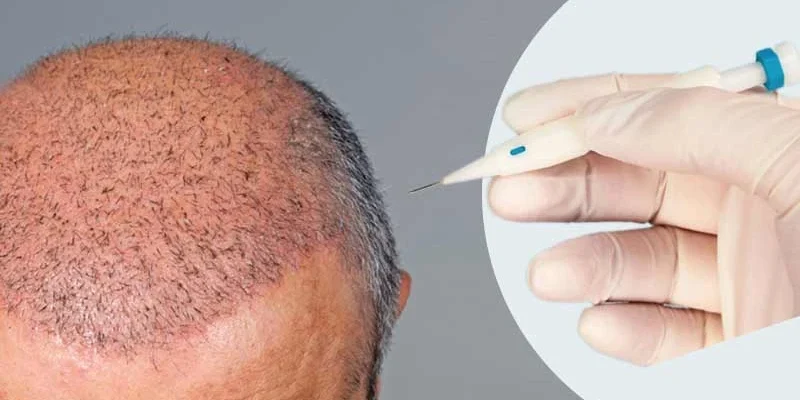
A DHI hair transplant (often described as Direct Hair Implantation) is a modern approach to hair restoration that focuses on how grafts are implanted into the scalp. If you’ve been researching hair loss solutions, you’ve probably seen DHI positioned as a “premium” option, especially for people who want a natural hairline, tighter control over angles, and a careful, detail-oriented placement process.
Here’s the key idea: in most cases, the grafts are still harvested using FUE-style extraction (tiny punches that remove follicular units one by one). What changes with DHI is the implantation step, many clinics use an implanter pen (commonly referred to as a Choi-type pen) to place grafts directly, often without creating all recipient channels in advance. This can allow very fine control over direction, depth, and angle, which matters a lot for hairline realism and how the hair will style later.
How a DHI Hair Transplant Works?
A DHI hair transplant procedure usually starts the same way most modern transplants do: the donor area (typically the back and sides of the scalp) is assessed for density, hair caliber, and “safe zone” stability. After trimming (full shave or partial shave, depending on clinic policy and case needs), grafts are extracted carefully to protect the donor area’s appearance over the long term.
Once grafts are harvested, the implantation phase becomes the defining feature. Instead of placing grafts into pre-made channels with forceps, many DHI-style workflows load grafts into an implanter pen and place them directly into the recipient area. The pen can create the entry point and implant the graft in a single motion, which is why clinics often describe it as a precision-driven approach for hairline work and dense packing.
The tradeoff is time and labor. DHI placement can be meticulous and may take longer, especially when a large graft count is involved. That extra time isn’t automatically “better,” but it can be valuable when your case requires careful angle control (for example, a soft, natural hairline or restoration around the temples).
Choi Implanter Pen
The Choi Implanter Pen is a specialized tool used in the DHI hair transplant technique to implant hair follicles with high precision. This pen-shaped device allows surgeons to place grafts directly into the scalp without creating separate channels, making the procedure faster and more controlled. Each graft is loaded into the pen and implanted at a specific angle, depth and direction to achieve a natural hairline.
The Choi Pen minimizes trauma to the scalp, reduces bleeding and shortens recovery time. It is especially effective for dense packing and detailed hairline work, which is why it is a preferred tool in modern hair restoration procedures.
How is DHI Hair Transplantation Performed?
DHI hair transplantation is performed by extracting individual hair follicles and implanting them directly into the recipient area using a special implanter pen without opening prior channels. This technique allows precise control over angle, depth, and direction, creating dense and natural-looking results.
Step-by-Step DHI Hair Transplant Procedure:
- Consultation and Planning: The surgeon analyzes hair loss, evaluates the donor area, and designs a personalized hairline based on facial proportions.
- Local Anesthesia: The donor and recipient areas are numbed to ensure a comfortable procedure.
- Graft Extraction: Similar to the FUE technique, healthy hair follicles are individually extracted from the donor area, typically the back of the scalp.
- Direct Implantation with Choi Pen: The extracted grafts are loaded into a Choi implanter pen and inserted directly into the recipient area without creating separate incisions beforehand.
- Post-Procedure Care: After implantation, the scalp is cleaned, and detailed aftercare instructions are provided to support healing.
Who is a Good Candidate for DHI?
DHI can be a strong fit if your priority is refined placement, particularly in the frontal zone, hairline, or areas where directionality is crucial. People with mild-to-moderate hair loss often choose DHI to improve density without attempting to cover an extremely large area in one session. It’s also commonly discussed for work that demands precision, like temple points, eyebrows, or beard restoration in specialized settings.
That said, “best candidate” isn’t only about hair loss stage. Your donor supply matters, your hair characteristics matter, and your long-term plan matters. A clinic that focuses only on today’s cosmetic change (without discussing future hair loss) can leave you with an unnatural pattern later. The most reliable plans treat donor hair as a limited resource and design a result that still makes sense if your hair loss progresses.
Why Hairline Design Matters More Than the Technique Name?
Most people judge a transplant by the hairline. That makes sense: it’s the frame of the face, and it’s where unnatural work shows first. A convincing hairline is not a straight line, and it’s not created by placing the same type of grafts evenly like pixels. It’s built with subtle irregularity, gradual density transitions, and directional placement that matches how your natural hair grows.
This is where DHI-style placement can shine, when it’s used as a tool for artistic control, not as a shortcut or a brand label. The best outcomes usually come from a conservative, age-appropriate hairline that balances density with donor preservation.
Recovery Timeline
Recovery after DHI looks similar to other follicular unit transplants. In the first days, you’ll likely see redness and small scabs around the implanted grafts, along with some swelling that may travel down the forehead in certain cases. Most clinics provide a washing routine and strict instructions about sleeping position, touching the grafts, exercise, and sun exposure.
Around the third to fourth week, many people experience shedding of the transplanted hairs. This often alarms patients, but it’s commonly described as a normal phase where the follicles remain in place while the visible hair shafts shed.
New growth typically begins gradually around the 3–4 month mark, then becomes more noticeable as months pass. Many timelines describe meaningful cosmetic changes between 6 and 12 months, with continued maturation in density and texture beyond that—sometimes up to 12–18 months for the final “settled” look.
Advantages of DHI Hair Transplant
The advantages of DHI hair transplant include higher implantation precision, faster recovery, and denser, more natural-looking results. Because follicles are implanted directly using a special implanter pen, the technique offers better control over angle, depth, and direction.
Key Advantages of DHI Hair Transplant:
- High Precision Implantation: DHI uses a Choi implanter pen, allowing surgeons to control the exact angle and depth of each graft, which creates a more natural hairline.
- No Pre-Opened Channels: Unlike traditional FUE, DHI does not require opening channels beforehand, reducing tissue trauma and minimizing bleeding.
- Higher Density: Because grafts are placed closely and strategically, DHI hair transplant can achieve a denser appearance, especially in the hairline area.
- Faster Recovery Time: The minimally invasive approach helps reduce scabbing and speeds up the healing process.
- Suitable for Unshaven Transplants: DHI can be performed without fully shaving the recipient area, making it ideal for patients who want a more discreet procedure.
DHI Hair Transplant Risks
Any hair transplant is a medical procedure, and it should be treated like one. Common short-term issues can include swelling, redness, itching during healing, and temporary shock loss in surrounding native hairs. The more serious risks (like infection or poor growth) tend to be linked to factors such as poor sterility, rough graft handling, overly aggressive density plans, or weak aftercare guidance.
This is also why “who does what” matters. You want transparency about who designs the hairline, who performs the extraction, and who places grafts. DHI can be extremely technique-dependent because the implantation step is so hands-on. When a clinic is vague about staffing or rushes multiple patients through a day, it can be harder to trust consistency.
DHI Hair Transplant Miami Cost 2026
DHI hair transplant Miami cost in 2026 typically ranges from $7,000 to $14,000 depending on graft count and clinic expertise.
In Miami, DHI pricing is higher than standard FUE because the technique uses a Choi implanter pen for precise placement, requiring more time and surgeon skill. The final price depends on graft number, the surgeon’s experience, clinic reputation and whether extra services like aftercare packages are included.